7 Questions to Ask Before Hiring a Security Company in Malaysia
A buyer's checklist for choosing a security guard company in Malaysia: how to check a KDN licence, what a realistic quote must cover, how guards are supervised, and the red flags to walk away from.

Choosing a security company is one of the few purchasing decisions where a bad choice shows up as a break-in, a missed shift at 3am, or a failed client audit. Proposals from different companies often look alike on paper — so the questions you ask before signing matter more than the brochure.
This guide is written for factory managers, facility and property managers, JMBs and business owners in Malaysia. Use the seven questions below in your next meeting, and the checklist at the end to compare proposals side by side.
1. Is the company licensed by KDN — and is the licence in the contracting company's own name?
Every company providing security guard services in Malaysia must hold a private agency licence issued by the Ministry of Home Affairs (KDN) under the Private Agencies Act 1971 (Act 27). Operating without one is an offence.
Don't stop at "yes, we're licensed". Ask for:
- A copy of the licence, and check that the company name and registration number match the company that will sign your contract and issue your invoices. Some operators work under another firm's licence, which leaves you exposed if something goes wrong.
- The licence validity date. Licences are renewed periodically; make sure it is current and won't lapse during your contract. You can also check a company's licence status through the Home Ministry's online system. (For reference, here are our own licence and certificates.)
- Proof of insurance, such as public liability cover, and what it actually covers.
2. Who are the guards, and are they legally employed?
Ask where the company's officers come from and how they are employed. A credible answer covers:
- Local and foreign officers. Security companies are expected to hire Malaysians first, with foreign guards allowed only where local manpower is short. Every foreign officer must hold a valid work permit. A company employing guards without valid permits puts your site at risk of disruption if enforcement action is taken.
- Background checks before deployment.
- Statutory contributions such as EPF and SOCSO, and on-time salaries.
If your company is audited under RBA, Sedex/SMETA or a customer code of conduct, your security contractor will be audited as an on-site supplier too. Ask about recruitment fees, passport retention and working hours specifically — see our guide to RBA and SMETA compliant security.
3. Does the price actually cover a legal wage?
Since 1 February 2025, Malaysia's minimum wage is RM1,700 a month. Security guard posts usually run 12-hour shifts, so a realistic monthly rate must also cover overtime, EPF, SOCSO, uniforms, supervision, relief officers and the company's licence and insurance costs.
When one quote comes in far below the others, ask the company to explain how it covers these costs. In 2025, labour department inspections found security companies still paying guards below the minimum wage — an underpaid guard is a guard who is likely to quit, sleep on duty or not turn up.
The right comparison is not the lowest monthly rate, but the rate that reliably fills every shift for the full contract.
4. How many officers will cover my site — and who covers leave and absence?
A 24-hour post needs more than two people. Ask:
- How many officers are assigned to the post, and on what shift pattern?
- Who covers rest days, annual leave, sick leave and emergencies? A good company has trained relief officers who already know your site.
- What is the maximum number of hours an officer works in a week? Officers working excessive hours with no rest days are tired officers.
For example, at Black Gold Security a 24-hour post is typically covered by two officers on 12-hour shifts, supported by relief officers so every officer gets a weekly rest day. For clients with RBA, Sedex or SMETA audits, we add enough relief officers that no one works more than 60 hours a week.
5. How do you supervise guards and prove patrols were done?
This is where many security contracts fail quietly. A guard who is supposed to patrol every hour may not, and a paper logbook won't tell you.
Ask how the company:
- Verifies patrols, ideally with an electronic guard patrol system that records each checkpoint scan with a time stamp rather than a handwritten log.
- Alerts supervisors when a checkpoint is missed, so problems are caught during the shift, not at month-end.
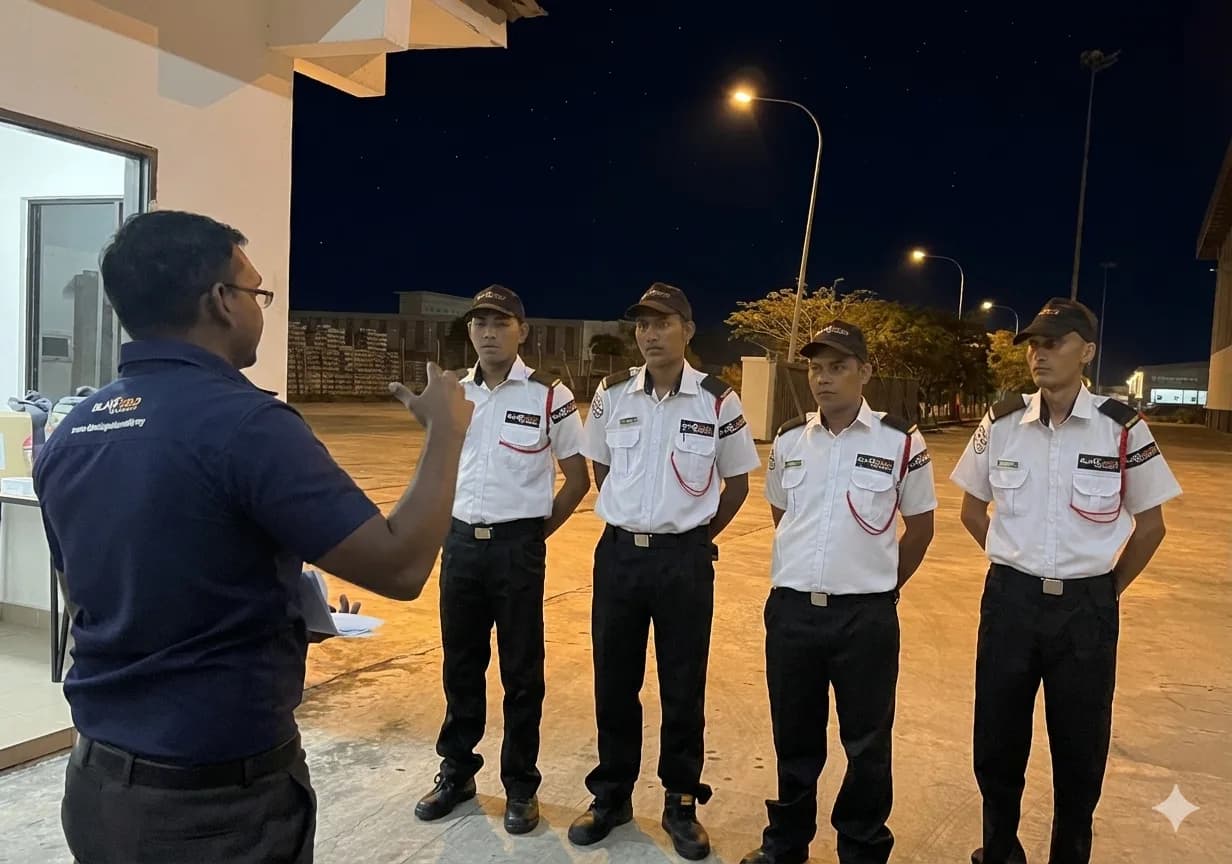
- Conducts supervisor visits, including unannounced night checks.
- Reports incidents — how fast, in what format, and whether reports include photos.
- Gives you visibility — can you see patrol records yourself, or do you only get a monthly summary?
6. What training do officers receive for my type of site?
Basic guard training is a starting point. A factory with loading bays and contractor traffic needs different skills from a condominium or an office tower. Ask about:
- Training specific to your site type — for example gate control, vehicle and goods inspection, visitor registration, or factory and warehouse security procedures.
- Fire safety and emergency response, and how officers are trained to coordinate with Bomba, police and your own team.
- How new officers are briefed on your site's standing orders before their first shift.
7. How will the service be reviewed, and how are problems handled?
Ask what happens after the contract is signed:
- Who is your single point of contact, and how quickly do they respond?
- How often will the company review your site — for changes in layout, operating hours or risk?
- How are complaints handled, and how quickly can a problem officer be replaced?
- What are the notice terms if service is poor?
A company that is confident in its service will be comfortable putting response commitments in writing.
Red flags to walk away from
- Can't or won't show a KDN licence, or the licence is in another company's name
- A quote far below the market that they can't explain
- Vague answers about how many officers will cover the post
- No way to verify patrols beyond a paper logbook
- No named supervisor or manager for your account
- Pressure to sign quickly
Quick checklist for comparing proposals
- KDN licence copy, in the contracting company's name and valid
- Insurance details
- Number of officers per post, shift pattern and relief arrangement
- Maximum weekly working hours per officer
- Confirmation of minimum wage, EPF and SOCSO compliance
- Patrol verification method and access to reports
- Supervision schedule, including night checks
- Training relevant to your site
- Named account manager and complaint process
- Contract notice terms
Talk to a security company in Johor Bahru
Black Gold Security is a KDN-licensed, ISO 9001 and ISO 45001 certified security company with 300+ officers protecting 70+ sites across Johor. We're happy to answer every question on this list in writing.
Book a free consultation to get a site assessment and a proposal for your premises, or read more about our security guard services in Johor Bahru.